
Please Choose Your Language
- All
- Product Name
- Product Keyword
- Product Model
- Product Summary
- Product Description
- Multi Field Search
TEL : +86-18920692288
Email : dwk0002025@163.com
Views: 0 Author: Site Editor Publish Time: 2026-08-10 Origin: Site


Modern metal fabrication demands constant evolution on the shop floor. Shops must balance tight tolerances against higher production throughput. Reducing scrap is a strict requirement for survival. Fabricators face a critical capital allocation decision. They must determine the exact operational threshold for equipment upgrades. Production volume and part complexity drive this choice. Skilled labor shortages also force shops to rethink traditional methods. Managers must justify moving from manual bending to automated solutions.
This guide provides an objective technical breakdown. We compare the mechanical and operational differences between manual and CNC systems. We evaluate the financial trade-offs without relying on outdated metrics. Operational leaders can use this data to select the right architecture. You will learn how to match machine capabilities to your specific manufacturing requirements.
Manual press brakes offer a low-cost entry point for prototyping and low-volume, simple bends, but rely entirely on the physical skill and consistency of the operator.
A CNC press brake machine drastically reduces setup times and guarantees repeatability for complex, multi-bend parts through automated backgauges and programmable ram control.
Upgrading to CNC technology requires evaluating long-term operational factors, including operator training, software integration, and the maintenance of hydraulic or electric drive systems.
High-tonnage or thick-plate applications often necessitate a heavy duty CNC press brake machine to maintain structural integrity and precision under extreme mechanical stress.
You must establish a baseline to understand traditional bending mechanics. Manual architecture relies entirely on physical linkages and operator input. This approach succeeds in cost control and offers simplicity for basic tasks. However, it fails when operations demand scalability. Complex geometries expose the severe limitations of manual control.
Industrial manual press brakes differ significantly from box and pan brakes. Pan brakes, or leaf brakes, use a lifting leaf to bend metal. They are limited to very light-gauge materials. You use them for low-volume sheet metal work. They lack the tonnage required for structural fabrication. Industrial manual press brakes use a vertical descending ram. They generate higher tonnage through mechanical flywheels or basic hydraulic cylinders. They can handle thicker materials but still require extensive manual setup.
Operating a mechanical press brake requires a deep understanding of material behavior. Manual press brakes rely on physical limit stops. The operator sets these stops to control the ram depth. This dictates the final bend angle. You must adjust the manual backgauge for every different bend. Operators walk to the back of the machine. They turn handwheels to move the backgauge block. They measure the distance with calipers or a tape measure. Legacy mechanical machines use a flywheel clutch system connected to pitman arms. Basic hydraulic models use simple directional valves. Neither system provides real-time position feedback.
Manual brakes remain viable in specific scenarios. They work well for one-off prototypes. Maintenance shops use them to fabricate simple replacement brackets. They suit low-volume, thin sheet metal work. Budget-constrained shops use them as entry-level equipment. If you only bend 90-degree angles on standard materials, a manual machine functions adequately.
Manual bending carries significant operational risks. Operator fatigue directly impacts part quality. Prolonged setup times destroy efficiency on multi-bend parts. You must stop and reset the machine multiple times for one complex part. Scrap rates rise due to human error during manual measurements. Maintaining tight tolerances across different shifts is nearly impossible. One operator sets a stop slightly differently than another. Material springback variations require constant manual tweaking. The operator must run a test piece, measure the angle with a protractor, and adjust the mechanical stops again to compensate for springback.
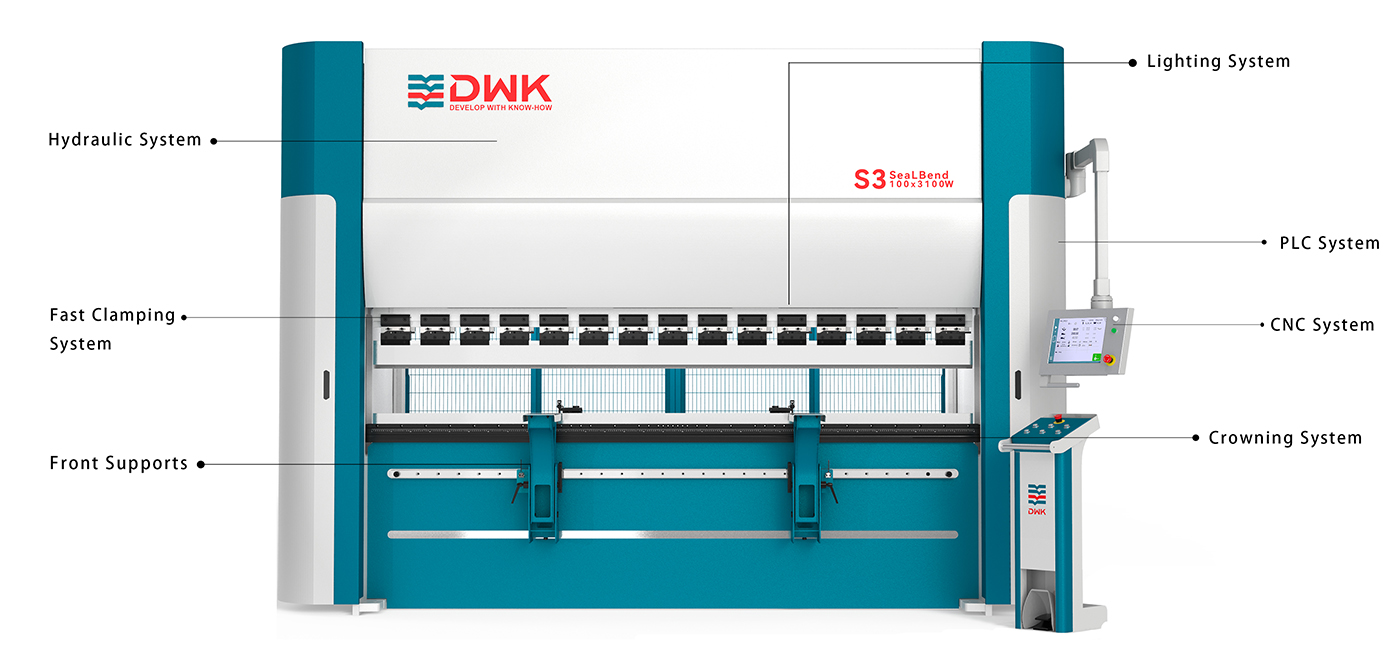
Modern fabrication requires a shift in bending technology. You must move from mechanical stops to closed-loop motion control systems. Automated architecture removes the physical guesswork from metal bending.
Numerical Control (NC) represents the first step away from manual operation. NC machines offer simple programmable stops. The operator inputs a target position. The machine moves to that position. However, NC lacks closed-loop feedback. It cannot verify if it actually reached the target perfectly. Computer Numerical Control (CNC) introduces dynamic multi-axis control. CNC systems constantly monitor ram and backgauge positions. They adjust movements in real time to ensure absolute accuracy.
Modern CNC models utilize advanced drive architectures. Hydraulic systems use dual cylinders controlled by proportional valves. These valves synchronize the left and right sides of the ram, known as the Y1 and Y2 axes. Electric systems use servo motors and ball screw mechanisms. They offer extreme speed and energy efficiency. Hybrid systems combine servo motors with localized hydraulic pumps. This dictates speed, precision, and energy consumption. Legacy mechanical systems cannot match the controlled acceleration and deceleration of CNC drives.
The CNC controller serves as the brain of the machine. It manages multi-axis backgauges. The X-axis controls front-to-back movement. The R-axis controls vertical height. The Z1 and Z2 axes move the backgauge fingers left and right. The controller also manages automated crowning. Crowning compensates for bed deflection under heavy loads using mechanical wedges or hydraulic cylinders in the lower bed. Operators input parameters like material type, plate thickness, and bend angle. The software auto-calculates the required tonnage. It determines the exact ram stroke needed. Advanced controllers allow offline 3D programming. Engineers create bend sequences in the office and send them directly to the machine via network connection.
CNC systems guarantee precision through optical linear scales. These scales mount to independent C-frames on the side of the machine. This isolates them from side-frame deflection under tonnage. They read the exact position of the ram down to 0.0004 inches. Real-time angle measurement systems use lasers or mechanical sensors. They measure the bend angle during the stroke. The machine adjusts the ram depth automatically to compensate for material springback. This ensures consistent bend angles regardless of material batch variations.
You must evaluate both architectures across several operational dimensions. This comparison reveals where automated systems outpace traditional mechanics.
Operational Metric Comparison
Metric | Manual Press Brake | CNC Press Brake |
|---|---|---|
Setup Time | High (Manual adjustment per bend) | Low (Instant program recall) |
Part Complexity | Limited to simple, single bends | High (Sequential multi-axis bending) |
Repeatability | Low (Dependent on operator skill) | High (Closed-loop optical feedback) |
Labor Requirement | Master craftsman needed | Software programmer / Operator |
Scrap Rate | High (Trial and error bending) | Low (Auto-calculated bend allowances) |
Production volume dictates your setup requirements. Manual machines require physical adjustments for every new part. This turns changeovers into hours of lost production. CNC systems recall saved programs instantly. The backgauge moves into position automatically. The ram depth sets itself. This reduces changeover times from hours to minutes. High-volume production demands this rapid transition capability. A 12-gauge bracket with three different bends might take fifteen minutes to set up manually. A CNC machine handles the same setup in thirty seconds.
Complex geometries expose the flaws of manual bending. A part with four different bends requires four separate manual setups. The operator handles the part multiple times, stacking work-in-progress parts on pallets between operations. A CNC system allows sequential bending in a single handling. The backgauge repositions itself between each stroke. The operator simply rotates the part. This scalability allows shops to bid on complex enclosure work.
Strict quality standards require documented consistency. Manual systems introduce variance with every single stroke. Operator fatigue changes the bend angle slightly by the end of a shift. CNC systems log production data. They ensure ISO-compliant repeatability. The optical scales force the ram to hit the exact same depth every time. You can guarantee part dimensions to your clients.
The fabrication industry faces a severe skilled labor shortage. Manual brakes require master craftsmen. These operators spend years learning how to feel the metal. They know exactly how to tweak a manual backgauge. Finding these craftsmen is increasingly difficult. CNC brakes shift the skill requirement. They move the burden from physical manipulation to software programming. Younger workers adapt quickly to touchscreen controllers and 3D interfaces.
Selecting the right automated system requires matching the configuration to your material types. Different drive systems excel in different applications.
A standard CNC hydraulic press brake machine serves as the workhorse of most fabrication shops. It balances high bending force with operational versatility. Dual hydraulic cylinders provide the necessary tonnage to bend mild steel and aluminum daily. Proportional valves ensure the ram descends evenly. This configuration offers exceptional reliability in general fabrication environments. It handles a wide variety of material thicknesses effectively.
Thick plate bending requires specialized architecture. You cannot bend thick structural steel on a standard frame. The mechanical stress will warp the machine. You must deploy a heavy duty CNC press brake machine for these tasks. These models feature heavily reinforced steel frames with deeper throat depths and larger daylight openings. They use larger hydraulic cylinders to generate massive tonnage per foot. Some applications require tandem configurations. Two machines sit side-by-side and operate as one massive unit. Heavy machinery manufacturing relies entirely on these robust systems to maintain structural integrity when bending high-strength materials like Hardox or Weldox.
Thin-gauge materials demand absolute precision. Aerospace, medical, and electronics enclosures require micro-tolerances. A standard hydraulic system may lack the delicate control needed. Shops upgrade to a precision CNC press brake machine for these jobs. These are often all-electric or high-end hybrid models. Servo-electric drives eliminate hydraulic oil temperature variations. This ensures the ram stops at the exact micron required. The multi-axis backgauges position small parts with perfect accuracy, allowing for consistent air bending on stainless steel enclosures.
Upgrading equipment requires a deep financial analysis. You must weigh the initial investment against long-term productivity gains. The cheapest machine often costs more to operate over a decade.
Initial procurement costs vary wildly across the spectrum. Entry-level DIY or light manual pan brakes require minimal investment. Industrial manual brakes demand a moderate capital outlay. Entry-level CNC systems represent a noticeable step up in price. High-end automated systems require significant capital investment. A fully equipped heavy-duty model represents a major financial commitment. You must secure appropriate financing based on projected revenue growth.
You must calculate the ROI timeline accurately. Automated systems reduce per-part labor costs drastically. Faster cycle times mean you produce more parts per shift. Automated angle correction reduces scrap rates to near zero. You stop throwing away expensive raw material due to bad bends. These productivity gains offset the higher initial CapEx. Most shops see a full return on investment much faster than anticipated.
Machine accuracy relies on tooling quality. Manual machines often use standard American planer-milled tooling. This tooling has wider dimensional tolerances. CNC capabilities demand an upgrade to European precision-ground tooling. Precision tooling is manufactured to exact specifications, often holding tolerances of 0.0004 inches. It allows the software to calculate bend allowances perfectly. You must budget for new punches and dies when upgrading. Using old, worn tooling on a new automated machine destroys your precision.
Drive systems impact your monthly utility bills. Traditional hydraulic systems draw continuous energy. The main gear pump runs constantly to keep the oil pressurized, even when the machine is idle. Modern servo-electric models offer extreme energy efficiency. They only consume power when the ram is actually moving. Hybrid systems also reduce energy consumption by utilizing variable speed drives to turn off the pump during idle times. You must factor these ongoing energy costs into your financial models.
Deploying new technology introduces operational friction. You must anticipate these risks to ensure a smooth transition. Proper planning prevents costly production delays.
The learning curve presents a major hurdle. Operators must transition from physical handwheels to CAD/CAM integration. They must learn the CNC controller interface. This frustrates veteran operators accustomed to manual methods. Partner with OEMs that offer comprehensive on-site training. Select machines with intuitive, visual touchscreen controllers. 3D graphical interfaces help operators visualize the bend sequence before stepping on the pedal.
Automated machines require specific physical environments. You cannot simply drop a high-tonnage machine on a standard concrete floor. Heavy-duty models require deep foundation reinforcement, often needing specialized rebar configurations and isolation pads. The electronics inside the controller require climate control. Extreme heat or dust will cause sensor failures. Audit your facility before purchase. Verify you have the specific 3-phase power requirements. Pour isolated concrete pads to handle the machine weight and vibration.
Maintenance shifts from mechanical to electronic. You no longer just grease gears and change hydraulic oil. You must troubleshoot optical sensors, servo motors, and proportional valves. A failed linear scale stops production entirely. Implement strict preventative maintenance schedules. Keep the optical scales clean. Monitor hydraulic oil cleanliness and adhere to strict micron filter ratings. Sign remote diagnostic contracts with the manufacturer. This allows their engineers to troubleshoot software issues over the internet.
The choice between manual and automated bending defines your production capabilities. Manual press brakes remain practical for budget-constrained operations. They serve maintenance shops and low-volume prototyping well. However, automated systems represent a mandatory upgrade for modern fabricators. If you compete on volume, complex geometries, and strict quality standards, you must automate.
Use a rapid decision framework to shortlist your options. First, calculate your average daily bend count. High counts demand automation. Second, define your required tolerances. If clients demand tight angle tolerances, manual bending will fail. Third, assess your material thickness variability. Frequent material changes require software-driven setup.
Conduct a detailed time-study on your most complex multi-bend part to identify current bottlenecks.
Request a live bending demonstration from an OEM using your actual material and specific part drawings.
Audit your current facility power supply and concrete foundation capabilities to ensure compatibility with new equipment.
Evaluate your current tooling inventory to determine the budget required for precision-ground tooling upgrades.
A: The baseline cost gap is substantial. Entry-level manual machines require a modest investment suitable for small shops. Industrial automated systems demand a significantly higher initial capital outlay. Pricing for automated models scales upward based on tonnage capacity, bending length, and the number of controlled backgauge axes.
A: Technically yes, but it is highly discouraged. Manual brakes often use standard planer-milled tooling with loose tolerances. Automated machines require precision-ground tooling to achieve their advertised accuracy. Using old, inconsistent tooling negates the precision benefits of the automated optical scales and software calculations.
A: Basic operation takes a few days. Operators can learn to load programs and run parts quickly using modern 3D touchscreens. Advanced offline programming and complex setup troubleshooting require several weeks of dedicated training and practice with the specific CAD/CAM software.
A: You must upgrade when bending thick plates or high-tensile steel regularly. Standard frames will deflect or crack under extreme tonnage. If your applications require hundreds of tons of bending force across a short span, a heavy-duty reinforced frame is mandatory for safety and accuracy.
A: NC offers basic programmable stops without closed-loop feedback. It lacks a graphical interface. CNC features dynamic multi-axis control, real-time positional feedback via optical scales, and advanced software that automatically calculates bend allowances and ram depth.
A: Yes, dramatically. Automated crowning compensates for machine deflection. Real-time angle measurement systems adjust the ram to account for material springback. Precise multi-axis backgauging ensures exact part positioning. This eliminates the trial-and-error bending process that causes high scrap rates in manual operations.


