
Please Choose Your Language
- All
- Product Name
- Product Keyword
- Product Model
- Product Summary
- Product Description
- Multi Field Search
TEL : +86-18920692288
Email : dwk0002025@163.com
Views: 0 Author: Site Editor Publish Time: 2026-08-25 Origin: Site


Sheet metal bending remains the most labor-intensive operation in metal fabrication. It relies heavily on manual dexterity and operator experience. Chronic shortages of skilled operators severely compress manufacturing margins. Demands for tighter tolerances, complex part geometries, and faster turnarounds compound this problem. Relying solely on manual labor to meet these production standards is no longer sustainable.
Transitioning from manual operations to an automated CNC press brake solves this core business problem. This upgrade shifts bending from an unpredictable, labor-dependent task to a scalable, data-driven production center. Manufacturers gain the ability to deliver consistent, finished products while drastically reducing reliance on hard-to-find manual operators.
Automation yields the highest ROI when addressing specific bottlenecks—robotic cells excel in high-volume runs and complex part manipulation, while Automatic Tool Changers (ATCs) unlock profitability in high-mix, low-volume (HMLV) environments.
Matching machine capacity to the application is critical; automating heavy plate bending requires specific structural rigidity to prevent exceeding tonnage-per-foot limits.
Evaluating automation requires looking beyond the machine's capital expenditure (CapEx) to include hidden implementation costs like offline programming (OLP) software, tooling upgrades, and expanded floor space.
Robotic systems cannot intuitively "feel" material inconsistencies; successful automation requires strict upstream quality control regarding material thickness and grain direction to manage springback.
You must quantify lost productivity before investing in automation equipment. Audit your current setup times versus actual green-light bending time. Manual setups often consume more shift hours than actual metal forming. Operators spend valuable time searching for tooling, reading prints, and running test bends. This non-value-added time cripples overall shop throughput.
To accurately assess your current bottlenecks, execute a formal shop floor audit using these steps:
Track the exact duration operators spend locating and loading punches and dies for each job.
Measure the time consumed by test bending and manual angle corrections.
Document the frequency and duration of material handling delays, such as waiting for forklifts or overhead cranes.
Record the number of scrapped parts generated during the initial setup phase versus the production run.
Analyze scrap rates and rework costs directly attributed to human factors. Operator fatigue leads to inconsistent handling and positioning errors. These errors multiply across large production runs. Evaluate the ergonomic toll and safety risks associated with manually maneuvering large sheet metal parts. Heavy plates require multiple operators or overhead cranes, slowing down cycle times and increasing injury risks.
Define specific target metrics to measure automation success. Aim for concrete reductions in cost-per-part. Set targeted increases for spindle or bending uptime. Establish desired labor reallocation ratios to move operators to higher-value tasks. Clear metrics prevent automation investments from becoming underutilized shop floor monuments.
Calculate projected cost savings from reduced labor hours and minimized scrap. Compare these savings against the lifecycle operational costs of the automated cell. Determine the required payback period based on current labor rates and projected throughput increases. Consistent production cycles allow for highly accurate forecasting, making ROI calculations much more reliable than manual bending estimates.
ROI Evaluation Factor | Manual Operation Baseline | Automated Cell Projection |
|---|---|---|
Green-Light Bending Time | Typically 30% - 40% of shift | Consistently 75% - 85% of shift |
Scrap Rate (Setup Phase) | High (requires manual test bends) | Near Zero (verified via offline simulation) |
Labor Requirement | 1-2 operators per machine | 1 operator managing multiple cells |
Cycle Time Consistency | Varies based on operator fatigue | Fixed and highly predictable |
Robotic bending cells integrate 6-axis articulated robots or Cartesian systems directly with the machine. These robots handle material staging, precise positioning during the bend cycle, and finished part stacking. The robot communicates seamlessly with the machine controller to synchronize movements. This eliminates the need for human hands near the pinch point.
Robotic manipulators easily handle complex parts through multiple bend sequences. They flip, rotate, and reposition materials without dropping or re-staging the workpiece. This continuous motion drastically reduces cycle times. The best use case for robotic cells involves long production runs of consistent parts. They also excel at handling heavy materials that pose ergonomic hazards. Robots can deliver a completely finished product, neatly palletized for the next manufacturing stage.
Integrators utilize different end-of-arm tooling (EOAT) depending on the material:
Vacuum Grippers: Ideal for flat, non-porous sheet metal, providing a secure hold without marring the surface finish.
Magnetic Grippers: Used for heavy carbon steel plates where vacuum cups might fail under sheer weight.
Mechanical Grippers: Deployed for parts with complex pre-formed geometries that lack flat surface area for suction or magnets.
Automatic Tool Changers revolutionize setup times for complex bending operations. These systems utilize automated tool storage racks and robotic shuttles. The shuttles swap punches and dies without any human intervention. The machine controller reads the part program and automatically configures the exact tooling layout required.
ATCs represent the best use case for high-mix, low-volume (HMLV) job shops. In these environments, frequent and complex setups often consume more time than actual bending. An ATC can change a full tooling setup in minutes, compared to the hours a manual operator might take. This keeps the machine running and producing parts, rather than sitting idle during changeovers.
Maximizing machine uptime requires moving programming from the shop floor to the engineering office. Offline programming (OLP) software allows engineers to create and verify bend programs while the machine continues producing parts. This eliminates the downtime associated with at-machine programming and manual test bends.
Modern 3D simulation software plays a critical role in this process. It verifies bend sequences and detects potential collisions between the tooling, the part, and the machine frame. The software also calculates exact robotic trajectories before physical production begins. Integrating the automated cell with shop-wide ERP or MES systems provides real-time production tracking. This data visibility helps managers optimize scheduling and monitor machine health.
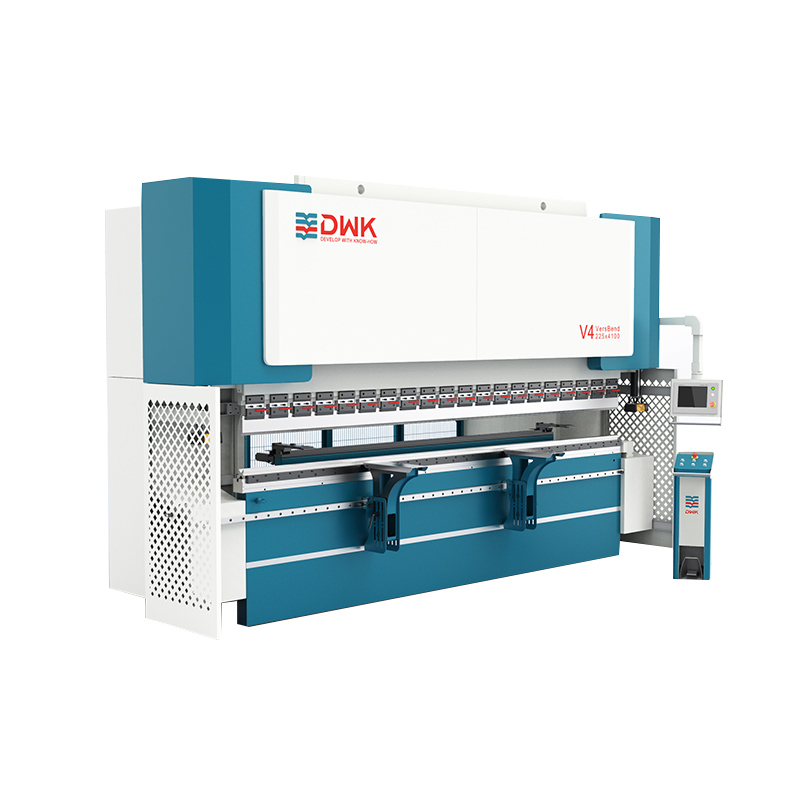
Automated heavy plate bending demands exceptional structural rigidity. Standard machines often lack the robust frames required for continuous, high-tonnage automated cycles. You must evaluate the machine's bed crowning and deflection compensation capabilities. Heavy bending causes the machine bed to bow slightly. Automated systems require dynamic crowning to ensure consistent angles across the entire length of the bend.
Technical realities regarding tonnage limits dictate machine selection. Manufacturers restrict machines to avoid exceeding twice the rated tonnage per foot. Pushing beyond these limits causes severe damage to tooling and the machine ram. A heavy duty CNC press brake provides the necessary structural integrity for thick plate applications. Automation software must be programmed to strictly respect these tonnage limits, as robots will not stop pushing if resistance increases unexpectedly.
Specifying a 320 ton CNC press brake fits perfectly for mid-sized structural components and thick materials. At this capacity, manual material handling becomes dangerous and inefficient. Robotic handling prevents operator injury and easily manages complex geometries. The automated system maintains strict cycle consistency, which is impossible for human operators wrestling with heavy steel plates over a full shift.
Scaling up to a 600 ton CNC press brake meets the demands of heavy industrial, mining, or agricultural equipment fabrication. These massive applications often require synchronized tandem press brakes working together. Heavy-payload robotic integrators are necessary to manipulate massive steel sheets. The automation system must coordinate multiple machine rams, heavy-duty backgauges, and high-capacity robots simultaneously to ensure precision on large-scale parts.
Manual bending operations typically achieve a utilization rate of only 30-40%. Setup times, material handling, and operator breaks consume the majority of the shift. Automated systems routinely achieve 75% or higher utilization rates. Robots do not take breaks, and automated tool changers eliminate setup delays.
This high utilization makes lights-out or unattended manufacturing shifts highly feasible. Running an automated cell overnight drastically reduces the overall cost-per-part. You amortize the equipment cost over significantly more production hours without adding direct labor expenses. Unattended shifts require reliable material feeding systems, automated part stacking, and scrap conveyors to function correctly without human intervention.
Automated material handling drastically reduces human error. Manual operators often lift and position parts inconsistently, leading to variations in bend angles. Robots place the material against the backgauge with exact, repeatable pressure every single time. This eliminates the minor positioning deviations that cause scrap.
Robotic precision excels in executing complex, multi-bend parts. The system maintains exact repeatability across thousands of cycles. Every finished product meets strict tolerance requirements. This consistency reduces downstream assembly issues, as welders and assemblers receive parts that fit perfectly together without requiring manual tweaking or rework.
Frame automation as labor optimization, not labor replacement. The industry lacks enough skilled operators to meet current demands. Automation allows you to maximize the value of the personnel you already have. You remove them from repetitive, physically demanding tasks and utilize their expertise elsewhere.
Transition skilled operators from physical bending to higher-value roles. They can manage process optimization, oversee quality assurance, and handle offline programming. Their deep understanding of sheet metal behavior makes them ideal candidates for programming and troubleshooting automated cells.
Production Metric | Manual Bending Operations | Automated Bending Cells |
|---|---|---|
Machine Utilization | 30% - 40% | 75% - 85%+ |
Setup Time (Complex Parts) | 30 - 60 Minutes | 2 - 5 Minutes (with ATC) |
Part Consistency | Variable (Operator Dependent) | Highly Repeatable |
Ergonomic Risk | High (Heavy Lifting) | Minimal |
Lights-Out Capability | None | High Feasibility |
Robotic cells require a significantly expanded physical footprint compared to standalone manual machines. You must account for safety fencing, light curtains, and laser scanners. The cell also needs dedicated staging areas for raw materials and finished goods pallets. Failing to plan for this space leads to cramped, inefficient shop layouts.
Mitigate this risk by conducting a thorough 3D spatial audit of the shop floor before procurement. Map out the exact dimensions of the automated cell, including the maximum reach of the robotic arm. Ensure forklift aisles remain clear and material flow to and from the cell is unobstructed. Account for the swing radius of the robot when handling the largest possible part in your inventory.
Assess your existing tooling inventory for automation compatibility. Automated tool changers require specific tooling styles. Punches and dies must feature self-seating mechanisms and standardized tangs for the robotic grippers to handle them securely. Legacy tooling often requires modification or complete replacement to work in an automated environment.
Address material variation proactively. Robots cannot intuitively adjust for thickness tolerance variations or springback like an experienced human operator. If a batch of steel runs slightly hard, the bend angle will change. Mitigate this by investing in real-time angle measurement systems. Laser or mechanical sensors integrated into the machine provide closed-loop feedback. The controller automatically corrects the ram depth on the fly to guarantee the correct angle.
Acknowledge the steep learning curve associated with new automation. Your team must master offline programming, robotic troubleshooting, and system maintenance. Throwing new technology at an untrained staff guarantees failure and prolonged downtime.
Mandate comprehensive vendor training programs for your key personnel. Use phased implementation schedules to build internal engineering competence slowly. Establish strict preventative maintenance protocols specific to robotic arms, ATCs, and automated safety sensors. Regular maintenance prevents unplanned downtime and extends the life of the automation equipment.
Initiate a formal time-study on current bending operations to establish baseline metrics for setup and cycle times.
Categorize your existing part library by automation viability, separating high-volume runs suitable for robotics from high-mix batches ideal for tool changers.
Request a detailed robotic simulation and cycle-time estimate from a qualified integrator using your specific part files.
Audit your available floor space and tooling inventory to identify hidden implementation requirements.
A: Costs vary widely based on the automation type and machine size. A basic robotic cell integration requires a moderate investment, while a fully automated system with an Automatic Tool Changer (ATC) and heavy-duty robotics requires a larger capital commitment. Always evaluate the investment against projected labor savings and throughput increases.
A: Traditional robotic cells struggle with high-mix production due to frequent gripper and programming changes. However, integrating an Automatic Tool Changer (ATC) and utilizing offline programming (OLP) software makes high-mix, low-volume (HMLV) production highly efficient and profitable.
A: Automated cells use 6-axis robots equipped with specialized vacuum or mechanical grippers. The offline programming software calculates the exact trajectory required to flip, rotate, and reposition the part between bends without dropping it, ensuring precise execution of complex geometries.
A: Yes. Automating thick plate bending requires a heavy-duty frame to withstand continuous, high-tonnage cycles. Standard frames may suffer from excessive deflection or permanent damage. Heavy-duty machines also feature dynamic crowning necessary for maintaining consistent angles on thick materials.
A: Robots cannot feel springback. Automated systems handle this by utilizing real-time angle measurement sensors, such as lasers or mechanical probes. These sensors measure the bend during the cycle and provide feedback to the controller, which automatically adjusts the ram depth to compensate.
A: Payload capacities range from a few kilograms for small parts up to several hundred kilograms for heavy plate applications. When sizing a robot, you must account for the weight of the raw material plus the weight of the robotic gripper itself.
A: Retrofitting is possible but often complex. The existing machine must have a modern, open-architecture CNC controller capable of communicating with robotic systems. It also requires compatible backgauges and safety interfaces. Often, purchasing a pre-integrated automated cell is more cost-effective.


