
Please Choose Your Language
- All
- Product Name
- Product Keyword
- Product Model
- Product Summary
- Product Description
- Multi Field Search
TEL : +86-18920692288
Email : dwk0002025@163.com
Views: 0 Author: Site Editor Publish Time: 2026-06-12 Origin: Site


Modern metal fabrication demands extreme precision across every production run. Industries like aerospace, medical device manufacturing, and automotive engineering require increasingly tight tolerances. Complex automotive brackets and intricate electronics enclosures leave absolutely no room for error. When you process expensive high-tensile materials, material scrap quickly destroys your profit margins. You need equipment capable of delivering perfect parts consistently.
Standard fabrication equipment struggles heavily in these environments. These basic machines fail to manage material springback effectively. They provide inconsistent bed crowning across long bends. Furthermore, standard machines rely heavily on operator intuition and manual adjustments. These issues create massive production bottlenecks. You waste hours on test-bending and manual tweaking instead of producing sellable parts.
This article provides a transparent, evidence-based evaluation framework. We will help your procurement and engineering teams shortlist the right high-precision bending equipment. You will learn the core technical criteria necessary for tight tolerances. We highlight specific model classes built for various production mixes. Finally, we expose real-world implementation risks you must prepare for before installation.
Precision is Systemic: True bending accuracy requires a combination of high-rigidity frames, dynamic crowning, and advanced multi-axis backgauges, not just sophisticated software.
Model Selection Matters: Specific configurations, such as the S3 100X-3100W and S2 100-2600-W, serve distinct production mixes based on tonnage, bending length, and speed requirements.
Processing expensive alloys requires perfect first-part execution. High-performance metals like titanium or specialized stainless steel cost a premium. Test-bending wastes these expensive materials rapidly. Upgrading to a CNC Press Brake solves this costly problem. Precision crowning systems ensure even angles across the entire sheet. Active angle measurement systems detect material variations instantly. They adjust the ram dynamically. You stop wasting expensive alloys on test runs. Scrap rates drop dramatically. Your material utilization reaches optimal levels.
Manual adjustments consume far too much time. Operators frequently spend hours tweaking machine settings for complex profiles. Modern equipment uses advanced offline programming. Software automatically positions the tools correctly. It calculates exact bend allowances instantly. This transition slashes setup times from hours to minutes. Throughput increases significantly because machines stay in production longer. You can handle smaller batch sizes profitably. High-mix, low-volume production becomes a major competitive advantage.
Master operators are retiring from the workforce rapidly. Finding highly skilled replacements is increasingly difficult. You can mitigate this reliance on veteran operators. Standardize your optimal bend recipes directly inside the machine controller. Junior operators can execute complex bends reliably by following digital instructions. We must remain realistic about this transition. Baseline operator training is still absolutely necessary. They must understand safety protocols. They must grasp basic machine operations. However, the machine handles the complex geometric calculations.
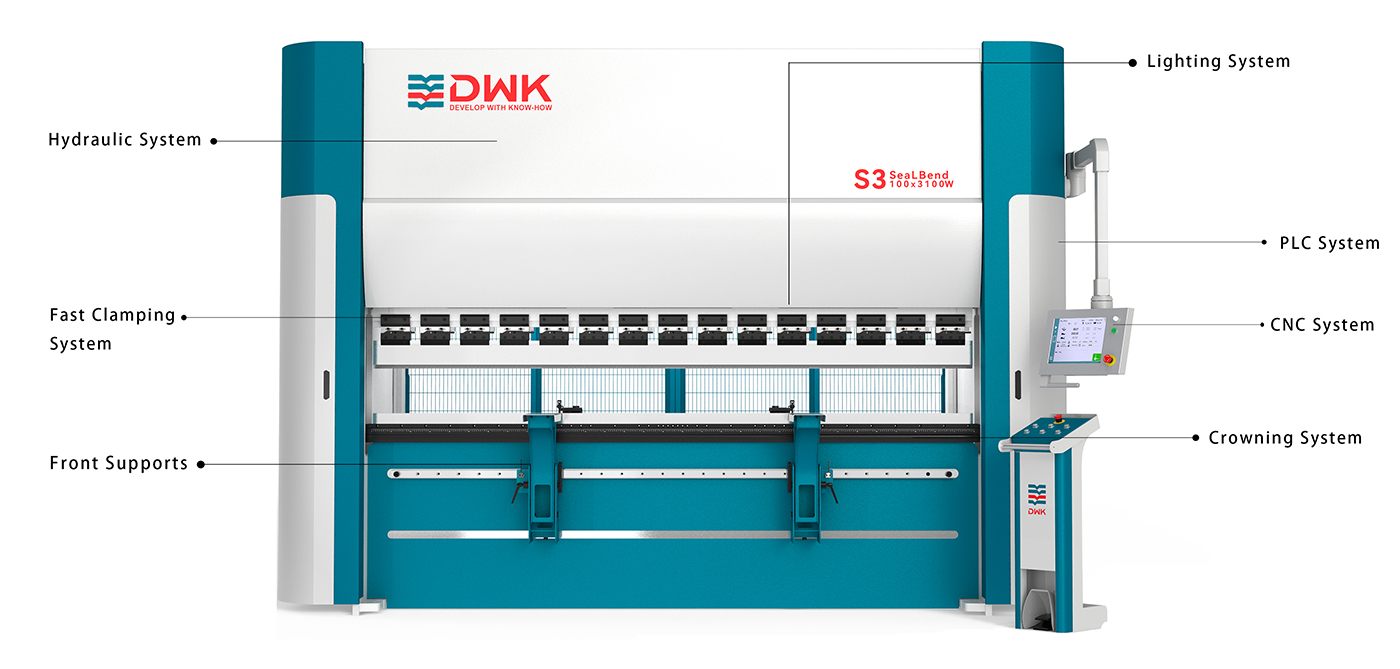
Machine deflection happens across all long bends. The upper ram and lower bed bend slightly under immense forming pressure. Dynamic crowning counteracts this natural curve. You must evaluate hydraulic versus mechanical crowning systems carefully. Hydraulic crowning uses cylinders built into the lower bed. They adjust pressure dynamically during the bend. Mechanical crowning uses precisely machined wedges. Motors drive these wedges to create a physical counter-curve. Mechanical systems often provide superior long-term repeatability. They do not suffer from hydraulic fluid temperature fluctuations.
The backgauge determines your primary positioning accuracy. You must align the backgauge complexity to your part designs.
4-Axis (X, R, Z1, Z2): This configuration handles standard precision work perfectly. The fingers move forward, backward, up, down, and side to side. It covers most traditional bracket and enclosure designs.
6-Axis (X1, X2, R1, R2, Z1, Z2): You need this for asymmetrical parts. It enables complex, multi-stage geometries. Independent fingers move completely separately. You can gauge angled flanges accurately.
Springback ruins perfect bend angles. Metals naturally attempt to return to their original flat state after forming. Active angle measurement fights this physical property. Real-time lasers scan the bend angle actively. Sensor-based systems touch the material to verify the angle. These systems adjust the ram depth on the fly. They compensate for springback predictably. You achieve perfect angles regardless of material batch inconsistencies.
Software runs the modern shop floor efficiently. 3D simulation prevents extremely costly machine collisions. Offline programming keeps the machine running continuously. Programmers create part files in the office. They send exact bending instructions straight to the controller. Seamless integration matters deeply. The machine controller must communicate smoothly with your existing ERP and CAM systems. This ensures accurate job tracking and inventory management.
Machine Class | Target Application | Key Technical Strengths |
|---|---|---|
Heavy-Duty Precision | High-volume, wide-bed processing (up to 3100mm) | Enhanced frame rigidity, deep throat depth, robust hydraulics |
Agile / High-Speed | Mid-size components, rapid cycle times (2600mm bed) | Faster ram speeds, high responsiveness, lower energy usage |
Ultra-Precision Electric | Small, intricate electronics parts | Micron-level positioning, zero hydraulic thermal drift |
High-volume jobs demand robust, heavily built equipment. This class targets wide-bed applications perfectly. You require sustained accuracy over a full 3100mm bending length. The S3 100X-3100W Press Brake excels in this exact environment. Key strengths include massively enhanced frame rigidity. A deep throat depth allows for complex flanging operations. It also features robust hydraulic synchronization. This ensures perfectly parallel ram movement even under extreme asymmetrical loads.
Mid-size components require rapid cycle times to maintain profitability. You cannot sacrifice repeatability for speed. This class handles high-mix fabrications seamlessly across a 2600mm bed. The S2 100-2600-W Press Brake delivers this necessary agility. Key strengths include much faster ram approach and return speeds. It consumes significantly less energy during standard operation. This machine offers incredible responsiveness. It handles high-mix, low-volume fabrication challenges effortlessly.
Small, intricate parts need entirely different mechanics. Electronics enclosures and medical instruments are prime examples. This class utilizes direct-drive servo electric motors. They offer micron-level ram positioning precision. They eliminate hydraulic fluid from the equation completely. You experience zero hydraulic thermal drift throughout the day. Accuracy remains perfectly identical from the morning shift through the night shift.
Buyers frequently ignore foundational requirements. Large equipment requires specific environmental preparations. You must ensure facility readiness before delivery.
Concrete Depth and Strength: Heavy frames require deep, reinforced concrete pads. Thin floors cause machines to settle unevenly.
Machine Leveling: Precision relies on perfect leveling. Uneven foundations twist the machine frame, destroying ram parallelism.
Temperature Control: Factories experience massive temperature swings. Heat causes thermal expansion in the metal machine frame. You must control the shop floor climate to prevent structural shifting.
Precision requires flawless forming tools. A high-end Press Brake fails completely if you use bad tools. You cannot use worn, standard tooling. Scratched or dented dies transfer errors directly into your metal parts. Precision-ground tooling is a mandatory concurrent investment. Segmented, precision-ground punches allow for highly flexible setups. They ensure the machine controller calculates bend allowances accurately. Do not upgrade your machine without upgrading your tool library.
Operators face a noticeable learning curve. They must transition from standard manual operations to advanced offline programming. You will likely see production dips initially. The first 30 to 60 days are challenging. Operators must learn entirely new control interfaces. They must learn to trust the automated backgauges. Management must anticipate this temporary slowdown. Provide dedicated training weeks. Do not panic during the transition period. The eventual throughput gains easily offset this early learning phase.
Never run machines at their absolute maximum limits. Pushing max tonnage constantly compromises structural accuracy. You must calculate required tonnage properly. Always consider material thickness, your chosen V-die opening, and the material's tensile strength. A solid industry rule of thumb exists. Always select a machine offering roughly twenty percent more capacity than your heaviest job requires. This buffer ensures the frame never stretches beyond its elastic limits.
Service level agreements protect your production schedule. Breakdowns halt your entire assembly line. You must scrutinize the warranty closely. Check local parts availability for specialized electronic components. Demand guaranteed response times in writing. You cannot afford to wait weeks for a replacement servo drive or safety laser component. Evaluate the vendor's local technician network carefully.
Buyers need absolute proof before authorizing payment. Demand a live test bend protocol. Bring your own complex part blueprints to the vendor. Ship your specific daily materials to their facility. Watch the machine perform your exact jobs in real-time. Measure the final parts carefully using precision calipers. Check the angles across the entire length of the bend. Complete this protocol before issuing any purchase order.
Finding the right high-precision bending equipment requires careful alignment. You must match exact technical capabilities to your specific shop floor bottlenecks. Evaluate backgauge axes, active angle measurement, and dynamic crowning systems thoroughly. True bending precision integrates rigid mechanical frames and smart software perfectly. You cannot rely on software to fix a weak machine frame.
Take decisive action to improve your fabrication capabilities. Consult an experienced applications engineer regarding your specific geometric challenges. Review exact technical specifications for advanced models like the S3 100X-3100W or the agile S2 100-2600-W. Schedule a customized time-study. Request a live demo using your toughest parts. Ensure your chosen equipment delivers the precise, repeatable results your clients demand.
A: Top-tier machines achieve impressive positioning tolerances. Verifiable industry standards rate ram repeatability around +/- 0.01mm. However, this accuracy remains highly dependent on external factors. Tooling condition plays a massive role in final part precision. Material consistency is equally important. Even the absolute best machine cannot fix poorly rolled steel.
A: Standard entry-level machines often rely on basic torsion-bar systems. These basic systems struggle to maintain parallel ram movement. The S3 100X-3100W uses advanced closed-loop proportional hydraulics. This system measures ram position continuously. It also features advanced native crowning. It actively compensates for bed deflection during extremely heavy bends.
A: No machine entirely eliminates material springback. Physics dictates metals will attempt to return to their flat state. Instead, advanced equipment compensates for it predictably. Active angle measurement systems scan the bend continuously. Software databases calculate the exact over-bend required. This delivers the correct final angle reliably every single time.
A: You can, but it is a risky decision. Worn or standard tooling inherently degrades output quality. A high-end machine depends on exact tool dimensions to calculate bends accurately. Transferring old, damaged tools will compromise your new investment completely. Purchasing new, precision-ground tooling ensures maximum accuracy and repeatability.


